|
| WELCOME
TO THE MUNGER-TRAIL LOGS |
|
•The Willard Munger State Trail
is a collection of multiple use trails between Hinckley and Duluth. It
consists of interconnecting trails offering hiking, bicycling, in-line
skating and snowmobiling. It highlights the picturesque scenery and
rich history of East Central Minnesota. The trail follows the route of
the railroad that saved many lives in the historic Hinckley and Cloquet
fires in the nineteenth century.
There
are three different trail segments in the Willard Munger State Trail:
Hinckley - Duluth segment, Alex Laveau Memorial Trail and Boundary
segment.
•The 63 mile Hinckley - Duluth
segment
of the Willard Munger State Trail is now completely paved, making this
the longest paved trail in the world. The trail extends between
Hinckley, Willow River, Moose Lake, Barnum, Carlton, and Duluth. The
trail passes near Banning State Park, through Finlayson, Willow River
and General C.C. Andrews State Forest, and through the spectacular
scenery of Jay Cooke State Park. The northeast portion of the trail
provides scenic views of the St. Louis River and the twin ports of
Duluth and Superior.
The Alex Laveau
Memorial Trail honors the memory of a former county commissioner and
dairy farmer who was a strong advocate of the idea of reusing abandoned
railways as public trails. This trail allows users to ride from
Gary-New Duluth 16 miles through Wrenshall into Carlton. Six new miles
of off-road paved trail from Carlton to Highway 23 are open. The
remaining miles are a combination of bike routes on paved highway
shoulders.
•The Boundary segment is a 80 mile
natural surface trail
used primarily for snowmobiling, horseback riding, hiking and mountain
biking. This trail passes through remote forests linking St. Croix
State Park with the Chengwatana, St. Croix and Nemadji State Forests.
Some areas may be impassable in summer.
•Many nearby DNR recreational areas Banning State Park, Moose Lake State Park, Jay Cooke State Park, St. Croix State Park, St. Louis River Water Trail, Chengwatana State Forest, St. Croix State Forest, Nemadji State Forest, General C.C. Andrews State Forest, Hemlock Ravine S.N.A..
•Willard Munger State Trail
Location:
Between Hinckley and
the southwest end of Duluth Distance: 69 paved
miles
•Description:
In
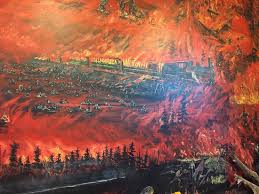
1894, a raging fire swept through Hinckley, and a train carried the
townspeople to safety, following the route that is now the Munger Trail.
•The Hinckley Fire Museum,
near the southern trailhead, tells the compelling story of this tragic
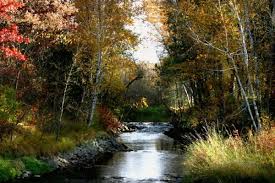
forest fire and its heroes. The trail passes fields, stands of woods,
and links several small towns.
|
|
Willard Munger Trail Log South
|
•One of the longest trail rides in
the state awaits
riders of the Willard Munger Trail named after the state representative
that served West Duluth for 43 years supporting many environmental and
recreational projects throughout Minnesota.
The southern segment
of nearly 55 miles, from Hinckley north to Carlton, and the northern
segment of about 15 miles from Carlton north to Duluth provides bikers
a wide variety of experiences from gambling to rock outcroppings, state
parks and lakes.
The southern segment, known as the Hinckley Fire Trail, goes though
Finlayson, Willow River, Sturgeon Lake and Moose Lake.
Side
trips can be made to Sandstone connected to the Munger with its own
part-trail, part-road route and three state parks: Banning, St. Croix
and Moose Lake.
Nearly all of the trail is flat and straight on
the bed of abandoned railroad right-of-way, although there is one spot
(M15) the trail takes a dip and curves. The trail crosses several
bridges, skirts ponds, crosses rivers and goes through the woods; there
are also a couple stretches that parallel a busy highway.
The
last 3.5 miles into Carlton were recently paved and takes riders
through a mix of wetlands, woods and even rock before skirting logging
operations.
Highlights along the trail, beginning at Hinckley
•M6
Skunk Lake historical site. In 1894 the railroad grade was an escape
route for the victims of the Hinckley fire in 1894 that destroyed six
towns and killed over 400 persons.
Skunk Lake today looks like
little more than a swamp, but during the fire storm many persons left
the train and escaped the flames in the swamp. Markers and a display
tell the story.
•M13
Finlayson depot offers a rest stop that includes an old depot and an
outside toilet. Refreshments and food are available at several
locations in the town that borders the western side of the trail.
•M15
The trail leaves its straight, hill-less route and dips up and down
hills to the east for nearly 1.5 miles. It’s a welcome relief if you
sometimes get bored with straight, flat rides. Enjoy the high speeds
and tight turns, but watch for other bikers and be alert for abrupt
turns.
•M17
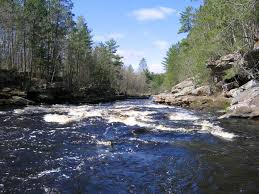
River crossings begin and offer new views and the sound of running
water. The Kettle River eventually leads into Banning State Park that
stretches north and south for several miles.
•M18
Rutledge, just to the east, is the half-way point between Finlayson and
Willow River.
•M23
Willow River has a grand entrance: the old railroad signal structures
on both sides of the trail. A small park area is nicely-kept and offers
a covered picnic area, inside toilets, playground and plenty of grass
for napping or picnicking. The town is split by the trail so plenty of
food and refreshments are close by.
•M24-26
Several river crossings that should whet your appetite for a canoe or
kayak trip.
From
here to Moose Lake, enjoy miles of sun-tanning open country with some
road noise from Hwy. 61 on the right that some will love and others
will want to use as a time trial. Enjoy the sun, bear down in the wind
and push for speed.
•M32
Moose Lake is the largest town along the trail between Hinckley and
Duluth. A trail through Moose Lake will take you to the next segment of
the Munger Trail .
•M 35.3
If you’d like a rest, stop at the bench that overlooks a pond.
•M 36.2
The first of two route into Barnum. Hwy. 6 goes into Barnum where
there’s food, water and friendly shop owners.
•M
38.4 Cty. 140 on your left is another route
into Barnum.
•M
39.6 The trail dips into a tunnel, perfect for
sitting out a rain or just hearing your voice echo.
•M42.5
The little town of Mahtowa pops up, but be careful. See that biker that
crashed into the wall of the building on your right?
•M46
If you don’t like to stop and smell the roses, this is a perfect spot
to sniff the wonderful barnyard smells of this farm, complete with
cattle.
•M48.6
The trail dips under the freeway and is a perfect hide-out if it rains.
•M49.5
Although Hwy. 61 is a companion on the left, there are all kinds of
natural wonders along the trail. A creek, some pines and those
signature rocks at this milepoint are part of this scene.
•M51.3
The trail that has been going into the woods goes over a small bridge
that’s a little bumpy.
•M52.3
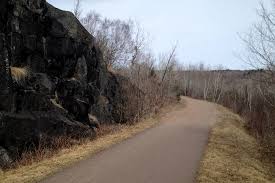
The trail cuts through rock that will be more evident in sections of
the Carlton-Duluth segment of the trail.
•M52.7
The trail comes out of the woods as it approaches the industrialized
area of Carlton.
•M53
A long fence keeps cyclists away from the piles of logs and the
railroad tracks that are still used.
•M54.5
The Hinckley-Carlton segment of the trail ends at the highway. If you
look across the highway you’ll see the beginning of the eight-mile long
Alex Laveau trail (see description elsewhere). Turn left and go .2
miles on the highway shoulder to the trailhead where there’s a toilet
(but no water). Some riders can meet a shuttle here and call it a day,
or you can continue on the trail all the way to Duluth, about 15 miles,
mostly downhill (see description elsewhere).
|
|
|
Willard Munger Trail Log North
The
northern segment of the Willard Munger Trail takes a 15-mile decent
from Carlton to West Duluth downhill through trees, rocks with a
powerful scenic views all the way.
Bikers can stop on a high
railroad trestle to enjoy a breathtaking look over the St. Louis River
estuary, cut through a mountain of rock, relax through fields of
wildflowers and northern pines, view the wonders of a hydroelectric
power plant, peddle through the largest stand of hemlocks and relax on
a hillside rest stop overlooking western Duluth and acres of water.
Highlights
along the trail into Duluth: M1 After starting with iron ore-looking
rocks on the left and the rapids of the river on the right, the trail’s
most spectacular view is at the first mile point on an old railroad
trestle high above the St. Louis River. Enjoy the North Shore feel as
you look out over rock formations, or hike down to the base of the
look-out area. Be careful of loose rock as well as slippery shorelines.
Save this treat for the return trip if you like desert at the end of
the ride.
M2
and 3
The map may throw you off, but at man-made Forebay Lake you’re looking
at part of the hydroelectric power system that produces more
hydroelectric power than any other in the state.
M4
Note the info kiosk and then a bit down the trail a bench; on these
ravine slopes is the largest native stand of hemlocks in the state.
M6
Stenman Crossing has a toilet, if needed.
M10
The trail passes on a trestle over a river and then takes bikers into
the first of rock “gorges” carved for railroad tracks. Their look is
awesome and rugged; some rocks are flat enough for seating. But don’t
get too wrapped up in the view while biking, because you’ll pop out of
the rocks close to the edge of a cliff.
M11
Enjoy a rest stop (no toilets or water, just a place to park a bike and
a picnic table) that is also an overlook of western Duluth. From this
Bardon Peak the ride is all downhill from here.
M13
Residential areas begin, and with it, traffic noise.
M15
The trail ends; to the right is Indian Point Park for camping.
|
Other Points of interest Along The Way
•Alex Laveau Bike Trail
An
eight-mile segment from Carlton through Wrenshall to Hwy. 23 south of
Duluth offers cyclists another opportunity to expand their ride in the
Duluth-Carlton area.
The ride from Carlton to Wrenshall has some
of the scenery of the ride from Carlton to Duluth. From Wrenshall to
Hwy. 23 the ride goes through lush, hilly farm land and is often draped
by trees.
This ride is best at dawn or dusk, especially from
Wrenshall to Hwy. 23, when the trail is most quiet, yet washed in rich
colors rather than lit up by a harsh sun.
From the Carlton trailhead, go about a tenth of a mile south on Cty.
Hwy. 1 to pick up the new trail on your left.
The trail follows an old railroad bed with Wrenshall the mid-point.
The
first 1.5 miles lead cyclists through rock that had to be cut for the
railroad. Alongside the trail are numerous ponds, popple and some open
area.
Then the trail hugs follows a more open area with a highway on
the
right. When the paved trail ends at about 2.9 miles, follow the highway
(on a paved bike lane) about 1.1 miles to the outskirts of Wrenshall.
When
you see the fire department and city hall, turn left on Parkwood Dr.
(Don’t turn right on Alcohol Dr.; Alcohol, as you know, is the road to
ruin.)
Go about .1 mile on Parkwood and watch for the trail popping up on your
right.
The
trail after Wrenshall is quieter, since there’s little highway noise;
the scenery is mostly beautiful farmland that was refreshing on a
delightful ride on a 6:30 a.m. early July ride.
The ride from Wrenshall to Hwy. 23 is 2.8 miles. Then turn around and
enjoy the ride, again, back to Carlton.
Some
cyclists follow 23 north into Duluth where access can be gained to the
Munger Trail’s northern end. But it’s quite a trek and not the easiest
route.
Willard
Munger Trail Towns
Carlton,
Hinkley, Finlayson, Rutledge, Willow River, Sturgeon Lake
•Carlton
has all kinds of lodging options, a half-dozen restaurants, unique gift
shops, old buildings, new buildings, hiking trails and other
recreational opportunities.
And no where else in the state can you enjoy the thrills of whitewater
during the day and casino gambling at night.
While
there is no tourist information center, nearly every business in the
area will be happy to give you the latest information on what’s going
on and directions on how to get there. That’s the friendliness of a
small town.
•Jay
Cooke State Park is about three miles from
Carlton and can be accessed by bike from the trail near M12.
The
park features hardwoods and spectacular views of the St. Louis River,
which thunders over rocks when the water level is high. Don’t miss
walking the swinging bridge that crosses the river.
An interpretive center offers programs and hands-on learning
experiences.
There
are 50 miles of hiking trails and 12 miles of off-road mountain biking
to add to the touring experience. Tent camping is available.
•Carlton
Daze at the end of July includes a 5K run/walk
and ultra marathon, softball and golf tournaments, games, crafts, food
and a parade.
•Carlton
hosts the National Whitewater championships
usually at the end of August. But you need not be just a spectator. If
you’d like to give the sport of whitewater rafting a try, check with
local businesses on how to find an outfitter.
•Duluth
is well-known for its tourist attractions, including: the maritime
museum next to the signature-attraction, the lift bridge; the railroad
museum downtown next to the art gallery; the warehouse district with
all the touristy spot; Skyline Drive that offers a panoramic view over
Duluth, as well as one of the best places to watch the annual
migrations of many raptors, in season; and the fascinating shipping
ports on Lake Superior that gives the whole area an ocean-like feel.
•The
North Shore and several state parks
that feature hiking trails, waterfalls and gorges are just up Hwy. 61
from Duluth. Fall weekends when the trees are in their most picturesque
splendor are popular times, even if things get a bit congested.
•Hinckley is
well-known by many travelers who’ve driven I-35 between the Twin Cities
and Duluth-North Shore, but there are many things to see and do in
Hinckley besides take a rest stop, including enjoying the Willard
Munger Trail.
Not only does the Willard Munger Trail begin in
Hinckley (and go all the way to Duluth), but other attractions make a
multi-day, multi-activity trip worth exploring.
Hinckley is home
to a nearby state park, a museum that describes the devastating
Hinckley fire, a casino that draws people day and night and a variety
of lodging and eating establishments.
And all along the trail are little towns that have established their
own identity.
Here’s a sampling of some of the major points of interest:
•The
Hinckley Fire Museum
just south of the trail’s beginning offers a glimpse into the old
logging days and the life of a depot agent, as well as the infamous
fire. A caboose and covered picnic area are also on the grounds.
•The
Hinckley Fire Monument,
a sobering reminder of the death toll from the infamous fire, is east
of Hinckley and 1-35 in the Lutheran Memorial Cemetery, just south of
four long trenches where 248 bodies are buried en masse.
•Hinckley
is the gateway to St. Croix State Park,
16 miles to the east on Hwy. 48. It’s the largest state park with
33,000 acres of forests, meadows, marshes and streams. Both the Kettle
and St. Croix rivers are accessible from the park.
The park hosts a daily schedule of demonstrations, talks, films and
slide shows, most with an interpretive naturalist.
And, if you’d like more biking, the park has six miles of surfaced
trails, besides the 127 miles of foot trails.
•Hinckley
hosts the “Corn and Clover Carnival” the first
weekend after the 4th of July with a full schedule of activities for
those looking for a small-town celebration.
•Grand Casino Hinckley
If
gambling is a part of your recreational calendar, the Grand Casino
Hinckley is open non-stop.
•Sandstone
is accessible from the Munger Trail via a short spur; another nice town
worth exploring.
•The
Kettle River, the first to be designated a
Wild and Scenic River, runs through the town.
•Robinson
Park
is located on the river; it’s the site of an old sandstone quarry
operated around the turn of the century. The remnants of an old wagon
bridge can easily be seen.
•Banning
State Park is also accessible east of
Sandstone, complete with falls, cave, campsites, hiking trails and the
usual state park amenities.
•The
Banning Quarry self -guided trail
in Banning State Park includes unique rock formations that are in
contrast to the trail’s landscape, and also offers an informative look
at the old days of quarrying.
•The
Kettle River
has a statewide reputation for whitewater canoeing and kayaking due to
its “kettles” and large holes that cause turbulent currents.
There is a series of five rapids, the toughest being Hell’s Gate,
that’ll challenge the most experienced.
•Outhouse
races during Quarry Days at Sandstone usually
the 2nd weekend of August, or bed races the 4th of July weekend in
Finlayson.
•Finlayson
most popular in the state and has produced record walleyes.
•Finlayson
is a quiet little town with just enough shops and restaurants to make a
stay worthwhile. Besides, you’ll probably get off your bike to use the
rest stop along the trail that includes an old depot, a few feet of old
railroad track to walk across and and outside toilet. A walk around
town will be a welcome respite.
•Finlayson
hosts a 4th of July celebration that includes
a volleyball tournament, old-fashioned barn dance and bed races.
•Rutledge
is the half-way point between Finlayson and Willow River.
•Willow River Days
held the last weekend in July.
|
|
|

Support Our Sponsors
 From Hinckley to Moose Lake call'em if you need a ride!
|