|
Due to some management problems with the site some links do not work properly we are working to repair the problems feel free to contact us for maps and other info you may need
|
|
Say there folks I have been getting a lot of requests for shuttle services for the trail
So I recently contacted Attaboys Taxi service and guess what!
They want riders hey! So give 'em a call if you need one along the trail!
Nice people, they told me they'll go all the way to Duluth and all they way to Hinkely! get a flat, getting tired etc... call'em
they'll shuttle your bike if it fits in the trunk!
Give them a ring at 320-245-5355 Or toll free at 866-998-8294 tell'em Munger-trail.com sent you!
Leave the drive back to Attaboy's! you'll be glad you did!
Attaboy Taxi services!
|
|
Need a Munger Trail Map?
Here's the link to the DNR's Official Munger Trail Map!
http://files.dnr.state.mn.us/maps/state_trails/tra00727.pdf
|
|
|
It’s the way it is, it’s the way it has always been Spring thaw, brings spring mud, ripples, birds It’s the way it is, the way it’s always been, Ever since: who knows when, when I was a kid.
|
|
Read more...
|
|
|
Egyptian scholars know there is little other than fiction that can be written about the civilization that lived on the banks of the Nile in far more recent times than the beginning of the 'Old Copper Culture'. All these things are related and the old fictions are replaceable with the story of a worldwide culture with trading posts in each and every part of the world. Is there any remnant of cultural pride in Iran that treats the ancient metallurgists of their region with a different kind of respect than our history attributes to them? Does anyone think these nationalistic ideologues and pedagogues of today are real and honest presenters of fact? The whole concept of nationalism and most other 'isms' (except ecumenicism) need close scrutiny. The area of the Snake River in east central Minnesota may have been the site of copper mining when the glaciers covered the Great Lakes. Would it be possible for people 20,000 years ago to have been mining these sites and lost their access due to the glaciers? We humbly suggest this is the case and that they then returned as the glaciers melted. Petaga Point and work by Peter Bleed in 1969 may offer a starting point for that kind of thinking. He wrote The Archaeology of Petaga Point: The Preceramic Component by the Minnesota Historical Society. |
|
Read more...
|
|
The Willard Munger State Trail is a collection of multiple use trails between Hinckley and Duluth. It consists of interconnecting trails offering hiking, bicycling, in-line skating and snowmobiling. It highlights the picturesque scenery and rich history of East Central Minnesota. The trail follows the route of the railroad that saved many lives in the historic Hinckley and Cloquet fires in the nineteenth century. There are three different trail segments in the Willard Munger State Trail: Hinckley - Duluth segment, Alex Laveau Memorial Trail and Boundary segment. The 63 mile Hinckley - Duluth segment of the Willard Munger State Trail is now completely paved, making this the longest paved trail in the world. The trail extends between Hinckley, Willow River, Moose Lake, Barnum, Carlton, and Duluth. The trail passes near Banning State Park, through Finlayson, Willow River and General C.C. Andrews State Forest, and through the spectacular scenery of Jay Cooke State Park. The northeast portion of the trail provides scenic views of the St. Louis River and the twin ports of Duluth and Superior. | |
|
Read more...
|
|
Minnesota carries quite a bit of political clout in the bicycling community. A few years back, the state was recognized by Bicycling Magazine for its cycling friendly representation. Perhaps one of the biggest voices is that representation has been Willard Munger, who for 43 years until his death in 1999 left his mark on environmental and conservation policies. The Willard Munger State Trail opened in 1989 and for many years it was the longest paved trail in the country. The trail was named Minnesota’s Millennium Trail for the year 2000. The 72-mile paved portion of the trail stretches from Hinkley to Duluth.
|
|
Read more...
|
|
One of the longest trail rides in the state awaits riders of the Willard Munger Trail named after the state representative that served West Duluth for 43 years supporting many environmental and recreational projects throughout Minnesota. The southern segment of nearly 55 miles, from Hinckley north to Carlton, and the northern segment of about 15 miles from Carlton north to Duluth provides bikers a wide variety of experiences from gambling to rock outcroppings, state parks and lakes. The southern segment, known as the Hinckley Fire Trail, goes though Finlayson, Willow River, Sturgeon Lake and Moose Lake. Side trips can be made to Sandstone connected to the Munger with its own part-trail, part-road route and three state parks: Banning, St. Croix and Moose Lake. Nearly all of the trail is flat and straight on the bed of abandoned railroad right-of-way, although there is one spot (M15) the trail takes a dip and curves. The trail crosses several bridges, skirts ponds, crosses rivers and goes through the woods; there are also a couple stretches that parallel a busy highway. The last 3.5 miles into Carleton were recently paved and takes riders through a mix of wetlands, woods and even rock before skirting logging operations. Highlights along the trail, beginning at Hinckley |
|
Read more...
|
|
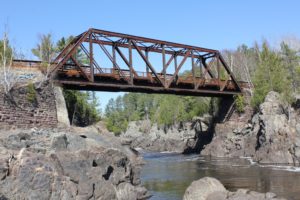
The northern segment of the Willard Munger Trail takes a 15-mile decent from Carlton to West Duluth downhill through trees, rocks with a powerful scenic views all the way. Bikers can stop on a high railroad trestle to enjoy a breathtaking look over the St. Louis River estuary, cut through a mountain of rock, relax through fields of wildflowers and northern pines, view the wonders of a hydroelectric power plant, peddle through the largest stand of hemlocks and relax on a hillside rest stop overlooking western Duluth and acres of water. Highlights along the trail into Duluth: |
|
Read more...
|
|
|
|
|