|
The Willard Munger State Trail |
E-mail
|
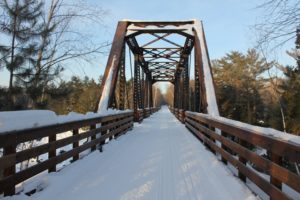
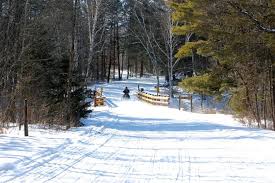
The Willard Munger State Trail is a collection of multiple use trails between Hinckley and Duluth. It consists of interconnecting trails offering hiking, bicycling, in-line skating and snowmobiling. It highlights the picturesque scenery and rich history of East Central Minnesota. The trail follows the route of the railroad that saved many lives in the historic Hinckley and Cloquet fires in the nineteenth century. There are three different trail segments in the Willard Munger State Trail: Hinckley - Duluth segment, Alex Laveau Memorial Trail and Boundary segment. The 63 mile Hinckley - Duluth segment of the Willard Munger State Trail is now completely paved, making this the longest paved trail in the world. The trail extends between Hinckley, Willow River, Moose Lake, Barnum, Carlton, and Duluth. The trail passes near Banning State Park, through Finlayson, Willow River and General C.C. Andrews State Forest, and through the spectacular scenery of Jay Cooke State Park. The northeast portion of the trail provides scenic views of the St. Louis River and the twin ports of Duluth and Superior. |
The Alex Laveau Memorial Trail honors the memory of a former county commissioner and dairy farmer who was a strong advocate of the idea of reusing abandoned railways as public trails. This trail allows users to ride from Gary-New Duluth 16 miles through Wrenshall into Carlton. Six new miles of off-road paved trail from Carlton to Highway 23 are open. The remaining miles are a combination of bike routes on paved highway shoulders. The Boundary segment is a 80 mile natural surface trail used primarily for snowmobiling, horseback riding, hiking and mountain biking. This trail passes through remote forests linking St. Croix State Park with the Chengwatana, St. Croix and Nemadji State Forests. Some areas may be impassable in summer. Nearby DNR recreational areas Willard Munger State Trail Location: Between Hinckley and the southwest end of Duluth Distance: 69 paved miles Description: In 1894, a raging fire swept through Hinckley, and a train carried the townspeople to safety, following the route that is now this bike trail. The Hinckley Fire Museum, near the southern trailhead, tells the compelling story of this tragic forest fire and its heroes. The trail passes fields, stands of woods, and links several small towns. The northern part of the trail makes a gradual, 15-mile descent from Carlton to Duluth. This very scenic stretch crosses a bridge high over the tumbling St. Louis River, passes through wooded Jay Cooke State Park, and follows a ridgeline with expansive views of forest, and eventually, Lake Superior and Duluth. At Carlton, the six-mile Laveau Trail branches off and heads southeast to Highway 23. For more information: DNR 651-296-6157, 1-888-646-6367 visit www.dnr.state.mn.us Banning State Park, Moose Lake State Park, Jay Cooke State Park, St. Croix State Park, St. Louis River Canoe & Boating Route, Chengwatana State Forest, St. Croix State Forest, Nemadji State Forest, Hemlock Ravine S.N.A., General C.C. Andrews State Forest. pdf map at: http://files.dnr.state.mn.us/maps/state_trails/tra00727.pdf Minnesota carries quite a bit a political clout in the bicycling community. A few years back, the state was recognized by Bicycling Magazine for its cycling friendly representation. Perhaps one of the biggest voices is that representation has been Willard Munger, who for 43 years until his death in 1999 left his mark on environmental and conservation policies. The Willard Munger State Trail opened in 1989 and for many years it was the longest paved trail in the country. The trail was named Minnesota’s Millennium Trail for the year 2000. The 72-mile paved portion of the trail stretches from Hinkley to Duluth. Millennium Trails is a national initiative of the White House Millennium Council in partnership with the Department of Transportation and its non-profit partner, the Rails-to-Trails Conservancy. Sixteen “National Millennium Trails” have been designated for their national significance. Each trail is marked with a special Millennium Trails sign with a national logo, and is featured on the web at www.millenniumtrails.org. While on the Willard Munger State Trail, users will encounter northern hardwood forests as well as jack, red and white pine and spruce fir. It’s not uncommon to spot white-tail deer, raccoom, red fox porcupine, beaver and muskrat. It’s also possible to happen upon coyotes, weasels, mink, bobcats and black bears. The trail includes three segments: The Hinckley-Duluth Fire Segment, the Alex Laveau Memorial Trail and the Munger East/Boundary Segment. Laveau was a former county commissioner and farmer who pushed for reusing abandoned railways as public trails. The Boundary segment is an 80-mile natural surface trail running through remote forests linking St. Croix State Park with the Chengwatana, St. Croix and Nemadji State Forests. Some parts of this trail, which is used for snowmobiling, horseback riding, hiking and mountain biking, may be impassable in summer. |
|
|